PikiP
ACOUS'TIPS #02 - Efficiency vs Sensitivity
Here two basic BR speakers with a nominal impedance of 8 Ohms have the same frequency response. An ambitious manufacturer would display a sensitivity of 98dB/W at 1 meter. However, with respective impedances of 5.3 Ohms and 6 Ohms, the efficiency changes significantly and depending on
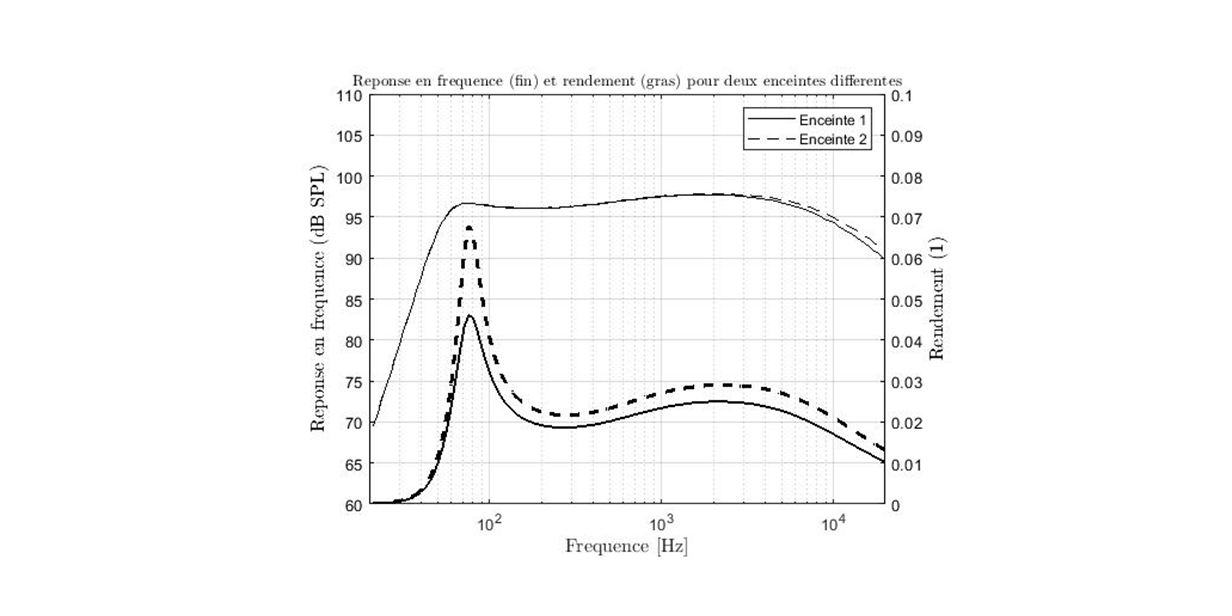
One piece of data always found on a speaker's technical data sheet is its SENSITIVITY, that is, the sound level it produces, in decibels SPL at 1 meter, for a nominal power of 1 electrical Watt. This is a value everyone refers to, and that manufacturers highlight to show the quality of their products. The higher the SENSITIVITY, the louder the speaker sounds. It is therefore an important piece of data, but one that is very often misunderstood and often subject to small "arrangements"...
SENSITIVITY is often confused with EFFICIENCY, even though these are two quite distinct concepts.
Speakers have an important characteristic called impedance, that is, the electrical resistance they present to an audio signal. To simplify things, two impedance categories exist: 4 or 8 Ohms (sometimes 16, but that is rarer). A speaker will therefore have a "nominal" impedance of 4 or 8 Ohms. Among other things, the nominal impedance is used to determine the input voltage used as a reference to measure SENSITIVITY. The formula is Pe = U² / Z, with Pe the electrical power, Z the impedance and U the input voltage.
For an 8 Ohm speaker, the SENSITIVITY measurement is therefore made with an input voltage of 2.83 Volts, since using the formula we indeed get 1 Watt - (2.83²)/8 = 1 W. Same for a 4 Ohm speaker where the input voltage used to measure SENSITIVITY is 2 Volts.
Unfortunately, the vast majority of speakers have a lower impedance than their nominal impedance. According to the standard, the impedance of a speaker with a nominal impedance of 8 Ohms can drop as low as 5.3 Ohms! So, two speakers displaying a nominal impedance of 8 Ohms may show an identical sound level but have very different power consumption.
The speaker that drops to 5.3 Ohms will dissipate 1.5 Watts for an input voltage of 2.83 Volts - (2.83²)/5.3 = 1.5 W -, that is, 50% more than the nominal power. In this case, the sensitivity value will be given for 1.5 Watts consumed and not 1 Watt.
A speaker with a nominal impedance of 8 Ohms actually shows an impedance variation ranging from 5.3 Ohms to a hundred or so Ohms depending on the frequency of the audio signal. Imagine the huge delta in energy consumption across the frequency band, but also from one speaker to another that nonetheless displays the same sensitivity and the same nominal impedance.
Finally, sensitivity is a single-point value meant to reflect the frequency response curve (FRF) at 2.83 or 2 Volts. This leaves room for interpretation, since it is possible to announce the sensitivity of a SUBWOOFER as 100 dB/W, while it only offers 90 dB/W at 40 Hz and 110 dB/W at 120 Hz... not false, but not fair play.
This is where the whole difference between NOMINAL POWER and ACTUAL POWER lies, and this is now where the concept of EFFICIENCY must come into play!
EFFICIENCY corresponds to the ratio between the acoustic power generated by the speaker and the electrical power dissipated (or consumed), so no cheating is possible.
η = Pacoustic / Pelectric
The calculation is a bit more complex, since acoustic power cannot be measured simply and directly: mathematical and physical detours must be used, but it is worth the effort since it then becomes possible to precisely quantify a speaker's electrical consumption.
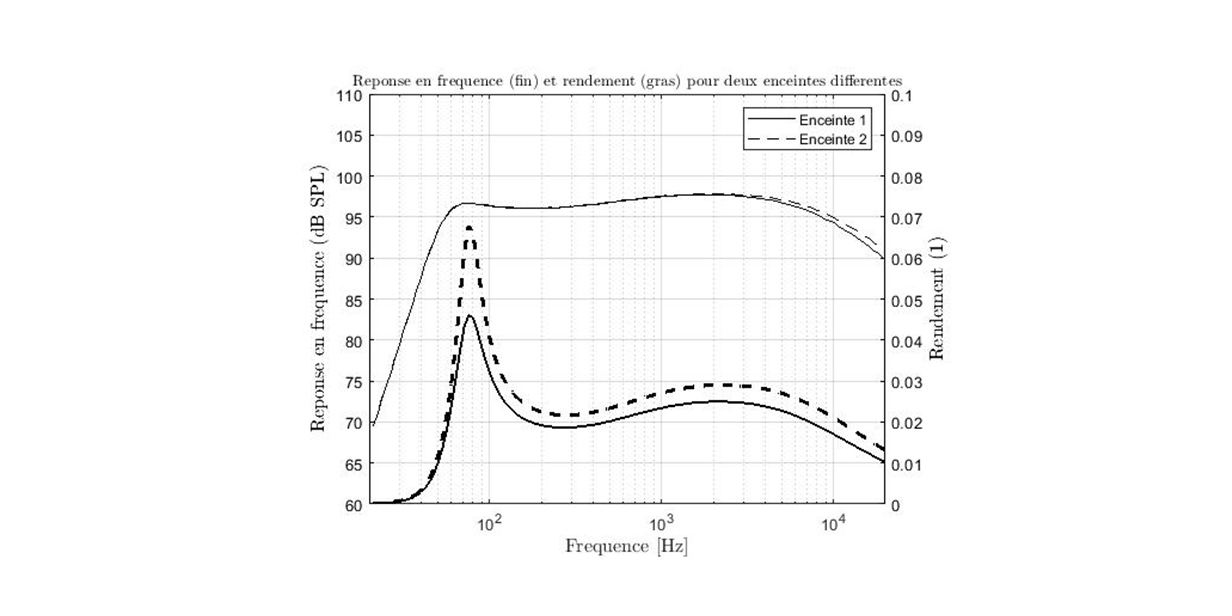
This is therefore the EFFICIENCY that we use at PIKIP SOLAR SPEAKERS to design and optimize our systems and enable the incredible autonomy you know!
Through our R&D work and our determination to reduce the consumption and power needs of sound systems, we are already very proud to offer speakers that already consume 10 TIMES LESS ENERGY than market standards.
In conclusion, keep in mind that a speaker's SENSITIVITY is an important piece of data, since it lets you know the sound level that can be obtained for a given input voltage, provided the information is not skewed since it is a single value and not a curve. However, it does not provide information on the power and energy required; for that, it is essential to use the somewhat more complex concept of ELECTROACOUSTIC EFFICIENCY.