PikiP
ACOUS'TIPS #03 - How to optimize the port of a bass-reflex enclosure?
\## Classic mass-spring system

Reproducing low frequencies (below 100 Hz) has always been the subject of specific research in the audio world. Indeed, generating low frequency acoustic waves requires moving a lot of air, using a long-excursion or large-size speaker.
Many methods have been found to increase reproduction efficiency and limit system dimensions (this is referred to as the acoustic load, the environment in which the speaker radiates). Among others: bandpass loads, horns, transmission lines, and above all the most used, the so-called bass-reflex load.
The bass-reflex
The bass-reflex is the most widespread load, found in all types of systems, in hi-fi as well as in sound reinforcement, from entry level to very high end. It allows extending the frequency response of a speaker in the low end, without overly stressing its thermal and mechanical capabilities. The principle is simple: it is the same as a beer bottle resonating at a given frequency when you blow into it, this is the Helmholtz resonance, whose frequency depends on the volume of the cavity and the length and area of the bottle's neck (technically called the port), following the formula: f = c/2pi x sqrt(A/(V*L)), where "c" is the speed of sound, "A" the port area, "L" its length and "V" the volume of the cavity.

At the port's tuning frequency, the speaker vibrates very little, and it is the air in the cavity that vibrates and radiates through the port.
Properly tuning a bass-reflex is not always easy, and results are sometimes unconvincing: an exaggerated low frequency response resulting in an unpleasant "boomy" effect is the typical result of a poorly tuned bass-reflex. A well-tuned bass-reflex, on the contrary, delivers a clear, deep response in a reduced volume.
Non-linearity of air
But not everything is so simple. Indeed, properly tuning a bass-reflex is a first step, but there is more. The pressure in the port can be very high, leading to a very high air displacement speed, and a non-linear behavior of the air. Unlike linear response, non-linear effects are complex and often counter-intuitive, and require the use of complex mathematical models, such as the finite element method (FEM), to describe visco-thermal acoustic phenomena.
But above all, these non-linear phenomena, typically starting from 145 dB SPL, cause major sound reproduction problems. The best known of these is flow noise: the air in the port creates audible noise that interferes with listening. Other phenomena exist, and we will discuss one in particular: compression.
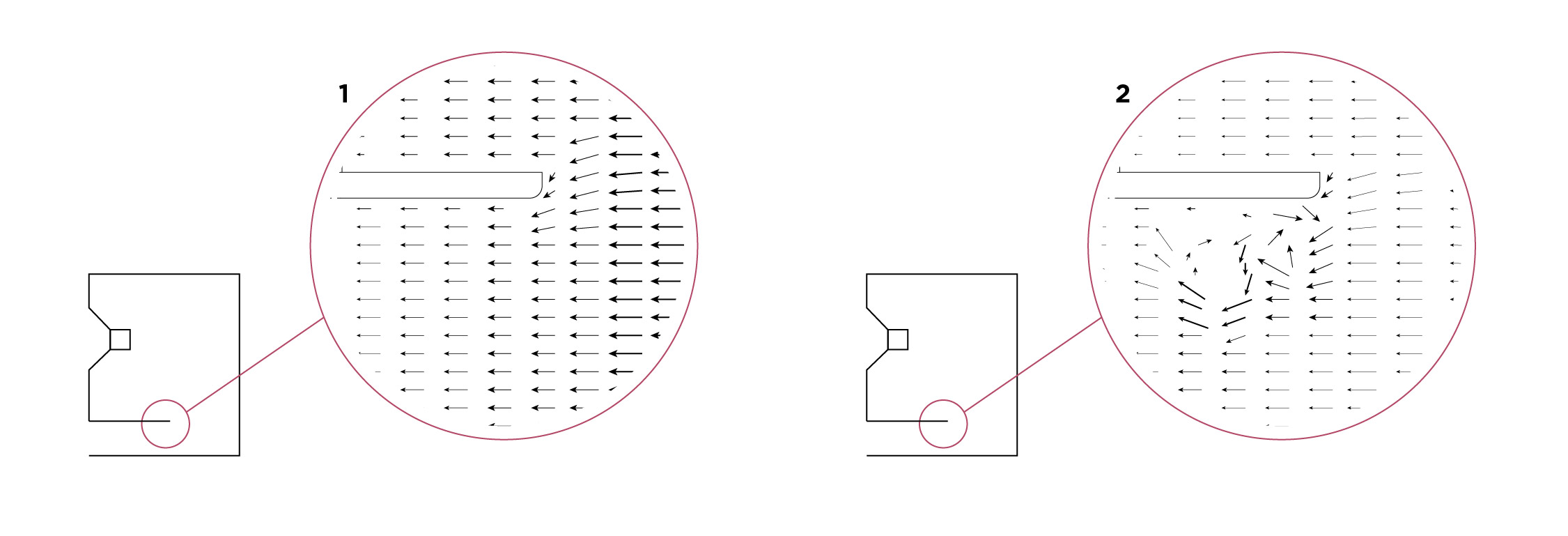
As a first approximation, an audio system is linear: meaning that the generated sound pressure is proportional to the electrical voltage across the speaker terminals. This is true up to a certain voltage, but at high levels the proportionality relationship no longer holds: the generated sound pressure increases less quickly than the input voltage, so electrical power is wasted and distortion appears.
Limiting turbulence
Indeed, the high pressure and high air speed in the port are sources of problems, particularly vortices that dissipate acoustic energy without creating sound waves. The flow is then said to be no longer laminar, but turbulent. This results in compression that can be quite significant, on the order of several decibels. In the example given, the rectangular port generates, for an electrical power of 50 Watts, almost 30% less pressure than the polynomial port.

To combat this phenomenon, Pikip has chosen two strategies: the first is to keep particle velocity low, by favoring very wide ports, which results in very low, absolutely inaudible flow noise.
In addition, Pikip ports are not simple rectangular ports as often seen, but have a curved profile (whose curve is polynomial) which greatly reduces the inertial separation of boundary layers, that is, the appearance of vortices.
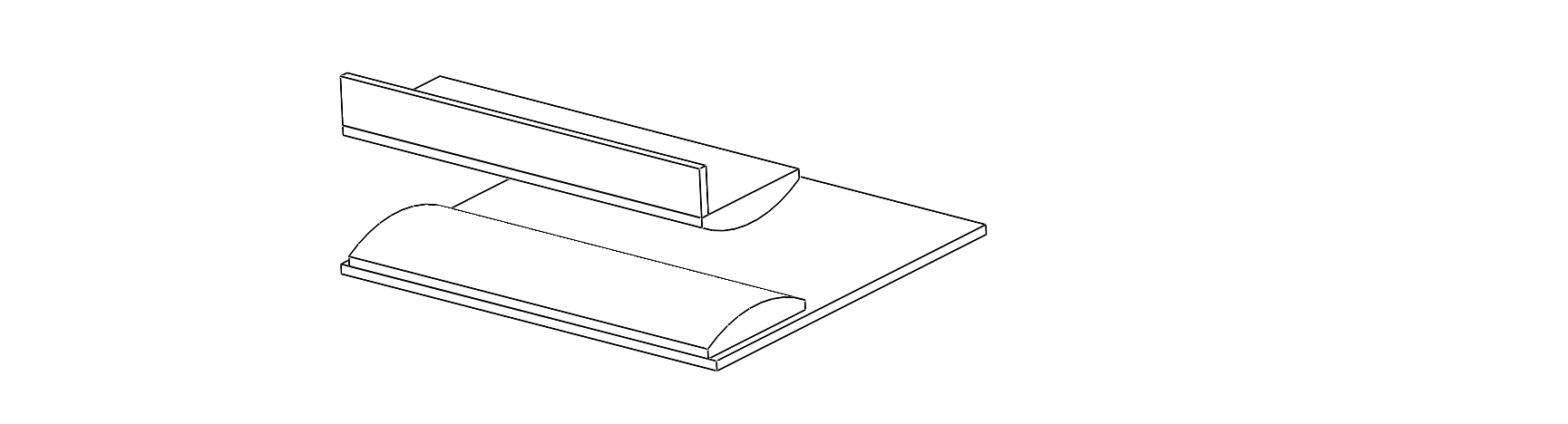
All this requires great care in design and optimization, through advanced simulations and precise prototyping, and the results are notable: very low compression and distortion, that is, an identical frequency response and sound signature regardless of listening level, and an efficiency that does not drop when power is high. This means gaining both in reproduction quality and in autonomy!