PikiP
ACOUS'TIPS #05 - Cardioid Configurations Against Noise Pollution
Two types of gradient configurations exist: the in-line gradient (with two elements) and the inverted gradient (three elements). The inverted gradient is the most used, and it is this method that we will describe here.
Most events where Pikip systems are used take place outdoors, in some cases close to residential areas or in city centers, which can in some cases generate noise pollution for the neighborhood.
This has been all the more critical since 2018 and the enforcement of the Decree of 7 August 2017 published in the Official Journal, known as the "sound" decree, on sound level limits in and around an event ( here >>).
To avoid this noise pollution, a solution exists: directivity control. This involves concentrating the sound energy on the audience, rather than having it reach the neighbors. While the issue of noise pollution arises relatively little for high frequencies due to their tighter directivity, low frequencies are more omnidirectional and require some cleverness. By combining several omnidirectional speakers, it is possible to modify the overall directivity of the system (just as with microphones!).
NB: Indoors, directivity control also makes it possible to reduce reverberation during a concert in an acoustically unsuitable venue. It allows a sound wave to be sent only into the useful zone and limits reflections off the rear walls.
Controlling directivity also helps avoid having too much low-frequency energy on stage, improving comfort for musicians by avoiding bass buildup.
Several methods for combining omnidirectional speakers have been developed. Among the best known are the inverted gradient and in-line gradient (cardioid) configurations, and the end-fire (pseudo-cardioid) configuration. Each method has advantages and disadvantages, and use cases depending on the size of the stage and the number of speakers, but they all aim to limit sound dispersion and focus acoustic energy in the desired zone.
The Cardioid in Gradient Configuration
Two types of gradient configurations exist: the in-line gradient (with two elements) and the inverted gradient (three elements). The inverted gradient is the most used, and it is this method that we will describe here.
In summary:
- Simple to set up
- Good directivity control
- Good impulse response
- Does not require many speakers.
This system was first described by Harry Olson in 1973 in the article "Gradient Loudspeakers." It is widely used at concerts due to its ease of implementation and relevance.
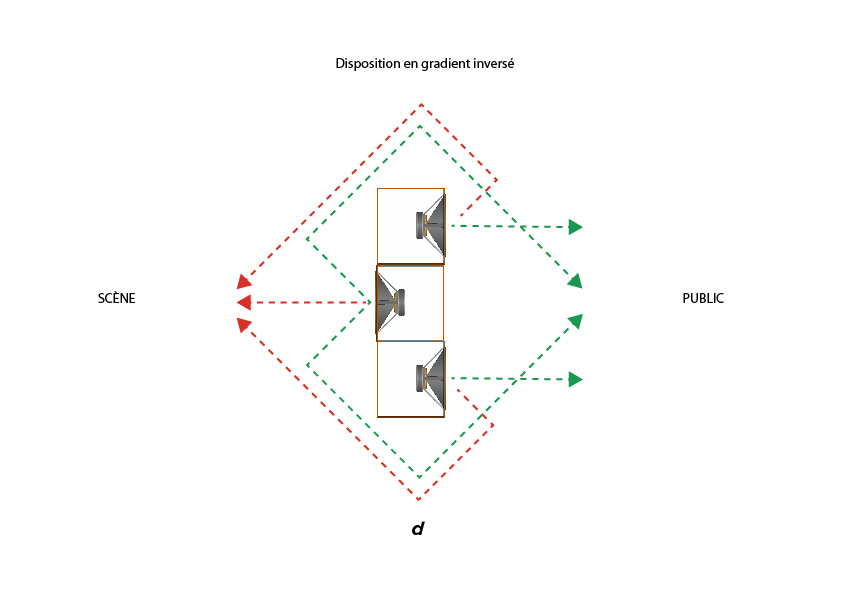
For an inverted gradient cardioid, the concept is as follows: it involves two speakers sending sound toward the audience and one reversed speaker that generates a wave in phase opposition, delayed, at the rear to cancel the sound (destructive interference).
How it works in detail
The speakers facing the audience have no delay applied and normal polarity, meaning no processing is applied to the signal they receive.
The signal of the reversed speaker has its polarity inverted. In addition, it is delayed by a delay corresponding to the following formula:
Delay = d/c
d being the distance between the driver of the front-facing speaker and the driver of the speaker facing away from the audience, and c the speed of sound in m.s-1, i.e. 343 m.s-1 at 20°C, taking into account the total size of the system that the wave must go around.
NB: It should be noted that the omnidirectional speakers in question actually have an attenuation close to -6 dB at the rear, which is why it is useful to reverse a speaker.
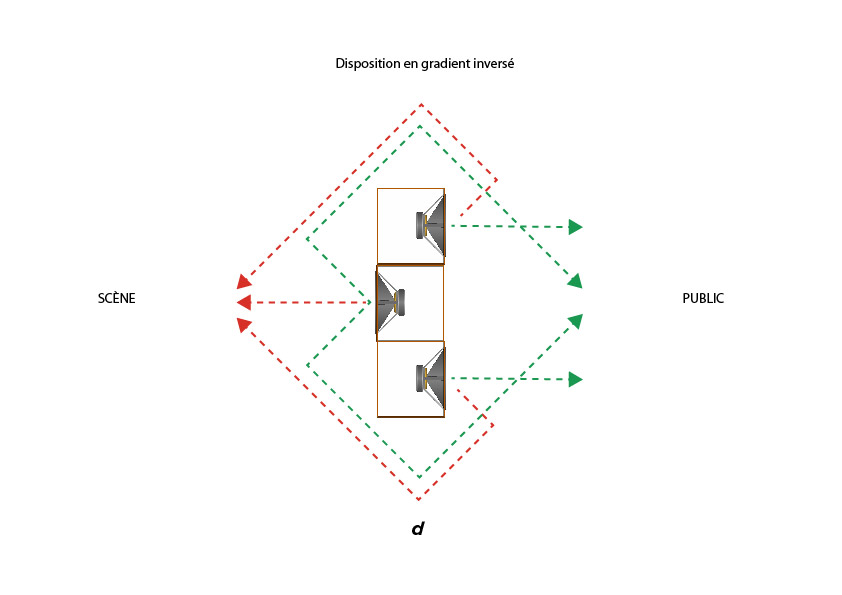
As for the front wave, the combination of the front-facing speakers and the reversed speaker simply creates a very slight phase shift. This results in an increase of 0.5 dB, instead of 3.5 dB if there were three speakers pointed toward the audience in phase.
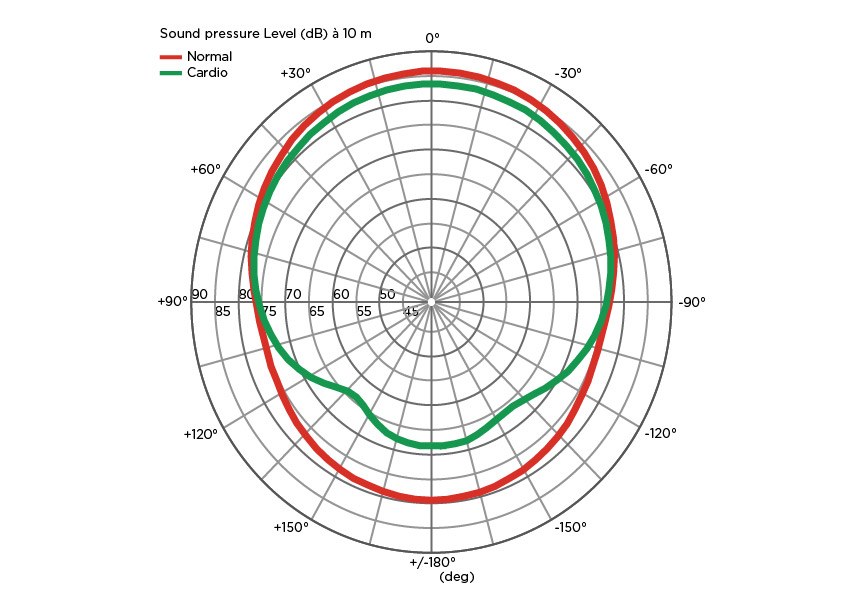
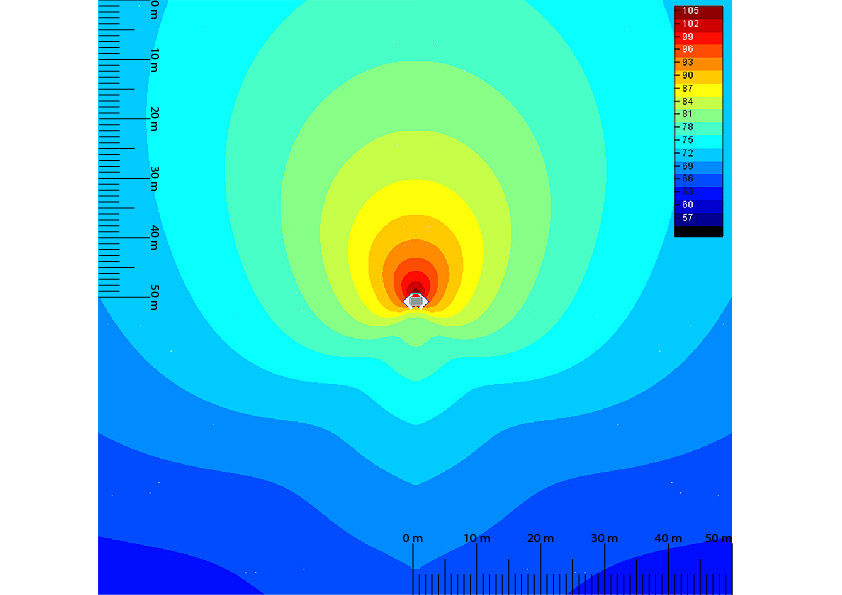
In the case of PikiP, our subwoofers are pseudo-omnidirectional to make it easier to achieve the cardioid pattern. Here are the results for a stack of 4 VTL118 in inverted gradient configuration:
Other Configurations:
In-line gradient
The in-line gradient consists of two speakers, spaced a distance d apart. The signal sent to the rear speaker is put in phase opposition and delayed by an amount corresponding to distance d.
End-fire
The end-fire configuration resembles the in-line gradient configuration due to the alignment of the speakers, but is quite different in the way it cancels waves at the rear. It involves a minimum of four speakers, spaced a distance d apart. The delays are applied such that all waves are in phase at the front. The rear waves have random phases, which creates broadband cancellation.
Conclusion:
The inverted gradient configuration makes it possible to efficiently create cardioid directivity with limited resources. Another configuration exists that avoids all these issues: the end-fire configuration. It allows for good directivity control while retaining the energy efficiency and impulse response of the speakers alone.
Pikip offers presets for the inverted gradient configuration, which is the most versatile and simplest to implement. If conditions allow, an end-fire setup is of course possible, and recommended, with Pikip speakers!