PikiP
ACOUS'TIPS #06 - Long-Throw Speaker: Myth or Reality?
Near/far fields
We often hear about the throw of a speaker, particularly in the low end, with the term "long-throw subwoofer" for example.
The term throw, or projection, refers to the distance the sound can travel while remaining "sufficiently" loud, up to where the speaker will be heard. Talking about a long-throw speaker therefore suggests that some speakers have the ability to project sound further than others. What is actually the case?
To understand this, we need to take a detour through a few acoustics principles, notably the different types of sources and the concepts of near and far fields.
Simple source
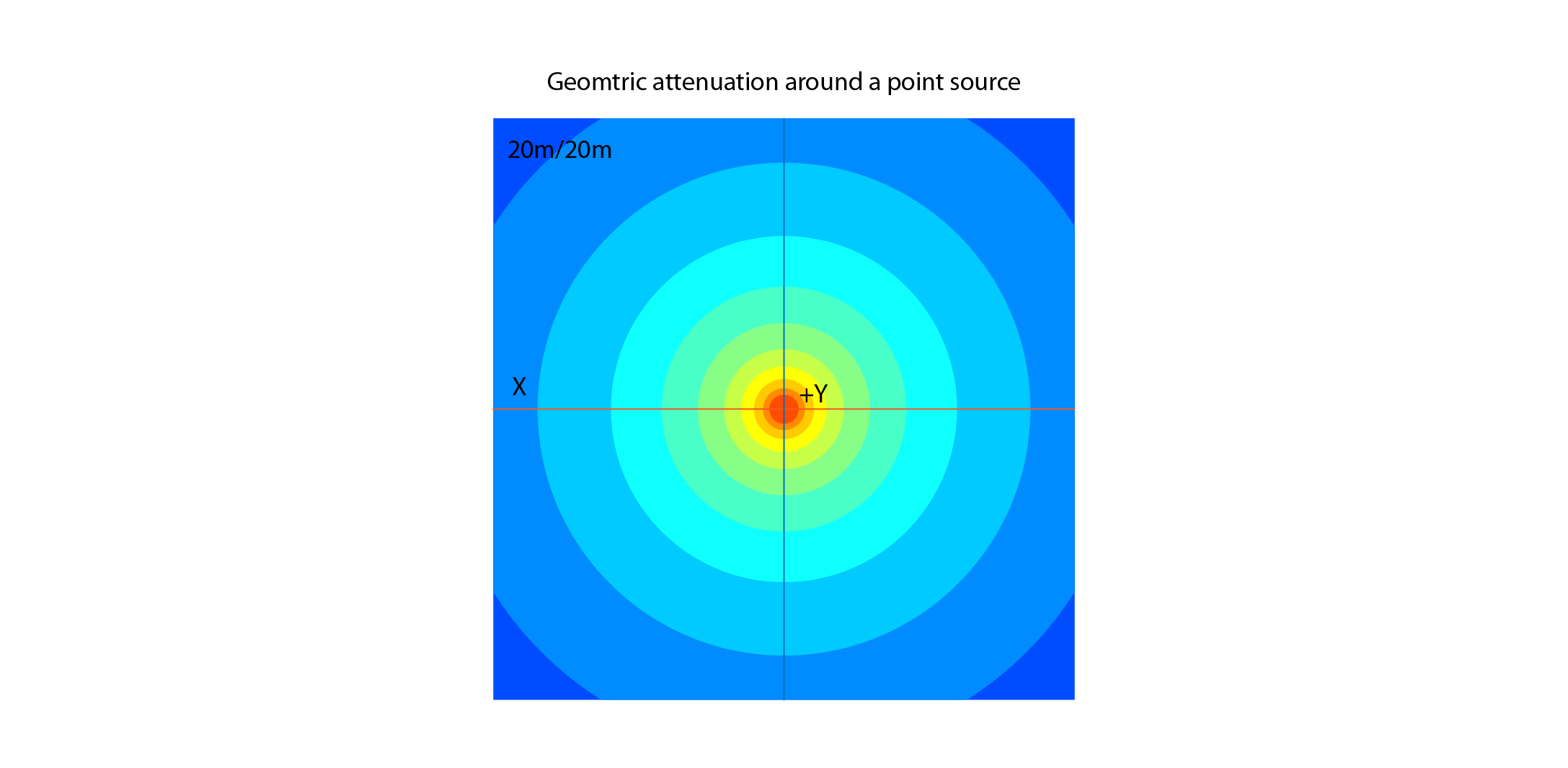
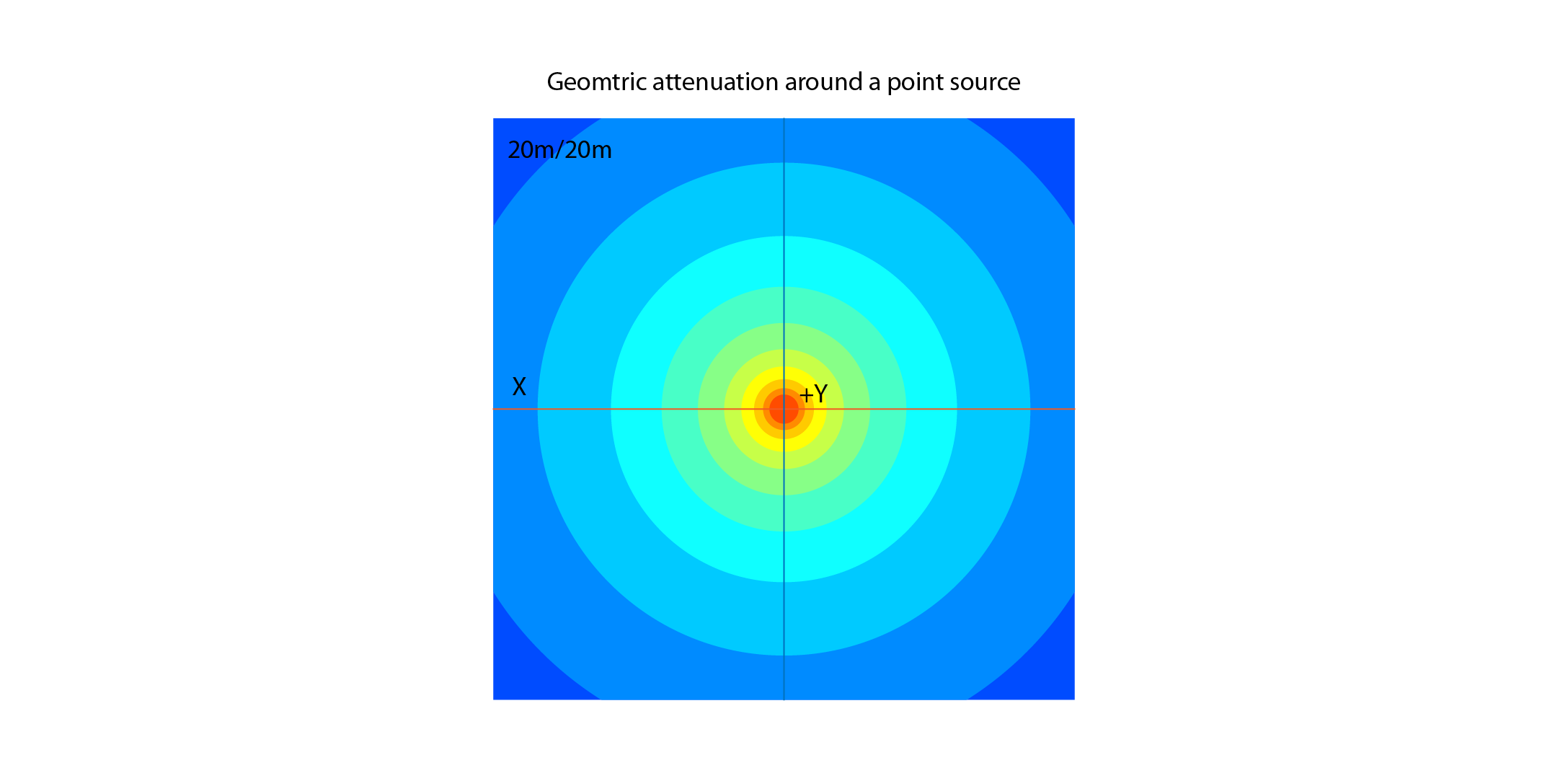
A point source, which is the simplest model of an acoustic source, generates an omnidirectional wave (meaning the wave propagates the same way in all directions, so the sound level is the same everywhere around the source), whose intensity at a distance r is I = P/ (4πr²), where P is the acoustic power emitted by the source. Note the term 1/4πr²; this means that every time the distance is doubled, the surface of the sphere representing the wavefront is multiplied by four. In terms of sound level, this means we observe a decrease of 6 dB each time the distance is doubled; this is called geometric decay, as opposed to absorption mechanisms that occur during propagation: imperfect adiabatic processes, friction, etc., in which acoustic energy is converted into heat.
Near/far fields
This decay law applies to all sources provided we are in the far field of the speaker, where pressure and wave velocity are in phase. In the near field, things are a bit more complicated. The limit distance between near field and far field depends on the frequency and the size of the source: the larger the source (for a given frequency), the further from the source the near field/far field limit is.
Directivity of a source
A bass speaker (subwoofer) can be treated as a point source, due to the ratio between its size and the wavelength of the waves it generates. It is therefore omnidirectional.
Conversely, a high-frequency driver (tweeter) tends to radiate sound only within a cone, with little energy outside that cone. The reason for this is also the ratio between the short wavelengths of high frequencies compared to the size of the driver.
It is also possible, for example using horns, to modify the directivity of a driver so as to send energy only into the zone of interest, which has the effect of changing the sound level between the axis of the speaker and the sides or rear.
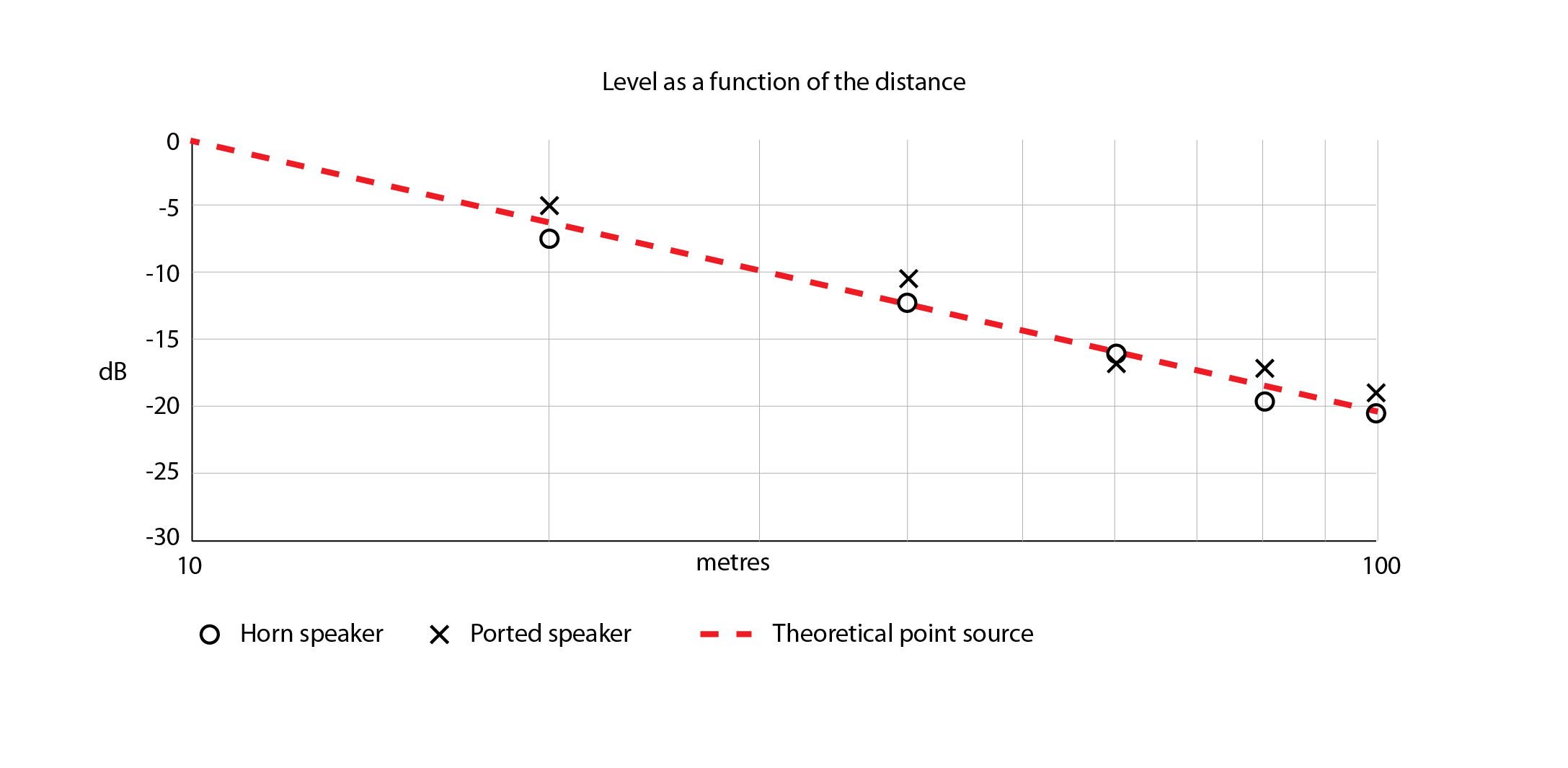
However, this does not change the geometric decay rule at all; once in the far field, the sound level will continue to decrease by 6 dB per doubling of distance, regardless of the directivity of the speaker, whether omnidirectional like a sub or highly directive, and regardless of its loading, direct or horn-loaded.
To be convinced of this, one only needs to measure speakers of different types and plot the decay curve.
Counter-example: the line array
So-called line-array speakers have the particularity of being sources that generate waves which decay by 3 dB per doubling of distance, in their near field. By following a few design and implementation rules, known as WST (Wavefront Sculpture Technology), and using many speakers arranged in a line, within a certain limit, the line array allows for a lower decay than a point source. This is referred to as a cylindrical wave (this is the case for the noise emitted by a busy road, for example).
However, beyond a certain distance, we fall back to the general 6 dB rule, with a spherical wave. This distance depends on the length of the line and the frequency of the wave, and is calculated using the formula D ≈ 1.57 × L² / λ
NB: a single line-array speaker behaves like a point source; it is by coupling many sources together that the principle described above is obtained.
Conclusion
A classic sound system, which can partly be treated as a point source model, generates a wave that decays by -6 dB per doubling of distance in the far field, regardless of its directivity or loading.
The only way to obtain a high sound level at a long distance from a source, whether omnidirectional or not, is to have a high level close to the source, regardless of the acoustic loading used, with the notable exception of line-source systems.
On the other hand, a directive speaker allows energy to be sent over the audience's heads and to reach distant points without having too high a sound level close to the speaker off-axis; this may be why we speak of long throw, but this does not change the 6 dB per doubling of distance law at all.
To conclude: the term long-throw speaker is a misnomer that does not correspond to an acoustic reality, it is better to speak of a directive speaker or a speaker capable of generating a high sound pressure level, depending on the case at hand.
To provide sound coverage for large spaces with a homogeneous level, meaning a moderate difference in level between the front and back rows of the audience using point-source speakers, several solutions exist: flown systems, use of delay speakers, or, as we have seen, directive speakers.